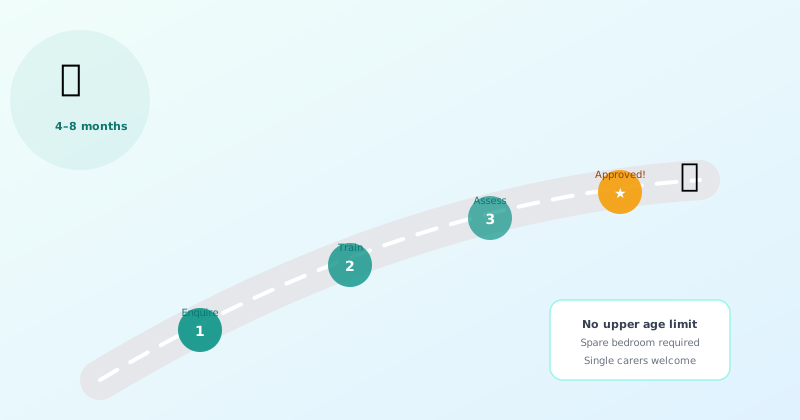
- Enquire with a local authority or independent fostering agency (IFA)
- Attend an initial home visit and information session
- Complete Skills to Foster training (usually 3 days)
- Undergo the Form F assessment (6–10 home visits over 4 months)
- Attend panel and receive your approval decision
Total timeline: 4–8 months from first contact to approval.
Step 1 — Choosing Who to Apply With
Your first decision is whether to apply through your local authority (LA) or an independent fostering agency (IFA). This matters because it affects your pay, support, and the types of children you'll care for.
- Local authorities typically pay allowances only (no fee), but many are well-supported and cover all placement types
- IFAs usually pay an allowance plus a fee, resulting in higher total income, and often provide more intensive support and training
There is no universally "better" option. Your choice depends on your income needs, preferred placement types, and where you live. Our guide on Local Authority vs IFA Fostering covers this in full.
Step 2 — Making Your Enquiry
Contact 2–3 agencies or your local authority's fostering team. You can do this by phone, online, or by attending a public information event. At this stage, they are finding out about you and you are finding out about them. Ask about:
- Their total weekly payment (allowance + fee)
- The types of placements they need carers for
- What support they provide day-to-day
- Whether they have a 24/7 on-call line
- Their Ofsted rating
Step 3 — The Initial Home Visit
A social worker will visit your home — usually within 2–4 weeks of your initial enquiry. This is informal and two-way. They want to understand your household, meet anyone you live with, and explain the process. They will check your home has a spare bedroom, but this is not a formal inspection.
After the visit, if you're both happy to proceed, you'll move to the formal application stage.
Step 4 — The Application and Checks
You'll complete a formal application form and consent to a range of background checks:
- DBS (Disclosure and Barring Service) check — enhanced, for all adults in the household
- Local authority checks — your own LA is contacted
- Medical assessment — your GP provides a health report
- Personal references — 3–4 referees who know you well
- DVLA check — if you will be transporting children
These checks take time. Don't worry if it feels slow — it is running in the background while your assessment proceeds.
Step 5 — Skills to Foster Training
All prospective foster carers in England must complete the Skills to Foster preparation course before their panel. This is usually held over 3 days (consecutive or spread over several weekends) and covers:
- Why children come into care and their likely experiences of trauma
- The impact of attachment and separation
- Contact with birth family — why it matters
- Record keeping and safeguarding
- Working with other professionals (school, social workers, health)
- Understanding the fostering role legally and practically
The training is not a test. It's designed to help you decide whether fostering is right for you, and to equip you if it is.
Step 6 — The Form F Assessment
This is the most substantial part of the process. A social worker (your assessing social worker) visits your home 6–10 times over roughly 4 months to complete the statutory Form F assessment. They will explore:
- Your childhood and family background
- Significant relationships (past and present)
- Parenting experience and styles
- Your motivation for fostering
- How your household would cope with a foster child
- Your understanding of the challenges
- Any past difficulties or vulnerabilities — and how you have overcome them
The Form F is not about finding perfect people. It's about understanding real people — their strengths, their history, and how they handle adversity.
Be honest throughout. Assessors are trained to work with complexity. People with difficult backgrounds, past relationships, and prior struggles are approved every day. What matters is your self-awareness, resilience, and commitment.
Step 7 — Fostering Panel
Your completed Form F goes to an independent fostering panel — a group of independent professionals and experienced foster carers. You attend in person (or via video call) and the panel asks questions before making a recommendation.
Panel then recommends either:
- Approve — you are a foster carer
- Defer — more information or time is needed
- Not recommend — you are not approved at this time
A decision-maker at the agency confirms the panel's recommendation. Deferrals are far more common than outright refusals. If deferred, you will be told exactly what is needed to proceed.
Step 8 — Your First Placement
After approval, you'll be added to your agency's placement matching system. The wait for your first child varies — from a few days for emergency carers to several weeks for those with specific preferences. Your supervising social worker will work with you throughout.
You don't have to say yes to every placement. You can discuss the details and decline if a child's needs feel beyond your current skills.
Frequently Asked Questions
How old do I need to be to foster?
You must be at least 21. There is no upper age limit.
Can I foster if I rent my home?
Yes. You need written consent from your landlord and must have a spare bedroom.
Can I work while fostering?
Yes, particularly for school-age children or respite care. Some placements — especially for very young children or those with complex needs — may require full-time availability.
What if I was turned down before?
Previous declination or withdrawal from an application is not an automatic bar. Circumstances change — contact a different agency and be upfront about what happened.