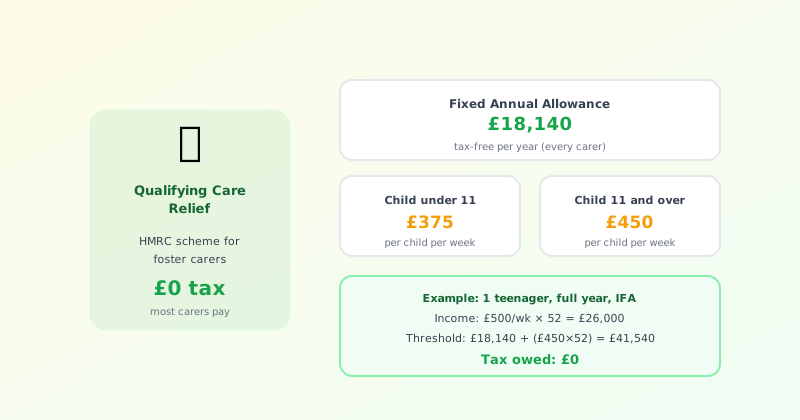
Foster carers in the UK are classified by HMRC as self-employed, but the vast majority pay £0 income tax. Under HMRC Qualifying Care Relief (Helpsheet HS236), you receive a £18,140 annual tax-free allowance plus £375–£450/week for each child fostered.
How HMRC Treats Foster Carers
Foster carers are classified by HMRC as self-employed. This means your fostering income is not taxed through PAYE — instead, you declare it annually via a Self Assessment tax return. However, HMRC provides a specific, extraordinarily generous relief scheme called Qualifying Care Relief (QCR).
How Qualifying Care Relief (QCR) Works
Qualifying Care Relief gives every fostering household a custom tax-free threshold calculated from two statutory parts:
- Part 1 — Fixed Annual Household Allowance: £18,140 per year (for the 2024/25 and 2025/26 tax years).
- Part 2 — Per-Child Weekly Allowance:
- £375 per week for each child under age 11
- £450 per week for each child aged 11 or over
If your total annual fostering payments (allowances + fees) are less than your total QCR threshold, your taxable fostering profit is £0. You pay no income tax and no National Insurance on that income.
Step-by-Step HMRC Self-Assessment SA100 Tax Return Example
Here is a concrete mathematical walkthrough showing exactly how to complete your HMRC tax return using the simplified Qualifying Care Relief method:
| Step / Calculation Item | Details for 1 Teenager (Age 14, 52 Weeks) | Details for 2 Children (Ages 7 & 13, 52 Weeks) |
|---|---|---|
| Total Fostering Income Received | £28,600 (£550/week) | £52,000 (£1,000/week) |
| 1. Fixed Annual QCR Relief | £18,140 | £18,140 |
| 2. Weekly QCR Relief for Children | 52 wks × £450 = £23,400 | (52 × £375) + (52 × £450) = £42,900 |
| Total QCR Tax-Free Threshold | £41,540 | £61,040 |
| Taxable Fostering Profit (Income minus Threshold) | £0 (£28,600 < £41,540) | £0 (£52,000 < £61,040) |
| Total Income Tax Payable | £0.00 | £0.00 |
How to Fill in the Self-Employment (Short) Form SA103S
When completing your online HMRC tax return or paper SA103S form:
- Box 1 (Description of business): Enter “Foster Carer”.
- Box 2 (Exempt from Class 4 NICs): Put ‘X’ in this box if you are a foster carer using Qualifying Care Relief.
- Box 9 (Business income / turnover): Enter your total fostering receipts for the year (e.g. £28,600).
- Box 20 (Qualifying Care Relief claim): Enter your total calculated QCR threshold (e.g. £41,540).
- Box 31 (Net profit): Enter £0.
Simplified QCR Method vs Traditional Accounts
| Comparison Factor | HMRC Qualifying Care Relief (Recommended) | Traditional Accounts (Actual Expenses) |
|---|---|---|
| Record Keeping | Simple: keep agency payment statements only | Complex: keep every food, heating, clothing receipt |
| Tax-Free Threshold | Generous (£41,540+ for 1 child) | Limited to actual verified expenses |
| Tax Outcome for Most Carers | £0 Tax in >95% of cases | Higher administrative burden; rarely better |
National Insurance (NIC) and Your State Pension
Because your net taxable profit is £0, you have no liability for Class 4 or Class 2 National Insurance contributions. To protect your UK State Pension qualifying years, you can apply for Specified Adult Childcare / Foster Carer National Insurance credits (Class 3 credits). Your local authority or agency supervising social worker can provide the confirmation letter required by DWP.
Does Fostering Income Affect Universal Credit or Benefits?
Under UK Department for Work and Pensions (DWP) statutory rules, fostering allowances are disregarded as income for Universal Credit, Housing Benefit, and Council Tax Support. Caring for a foster child does not reduce your benefit entitlement, and foster carers with a child in placement are exempt from work search requirements under Universal Credit conditionality rules.
Summary & Next Steps
Understanding your tax rights ensures you keep 100% of your hard-earned allowances. Use our free calculator to verify your exact threshold: