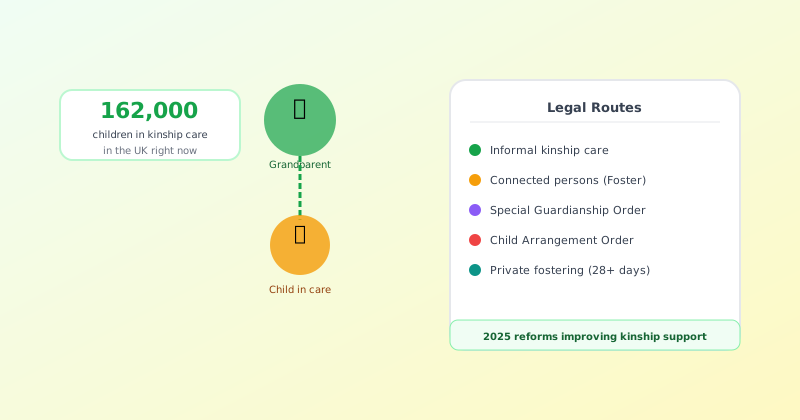
Kinship care: a child lives with a grandparent, aunt, uncle, sibling, family friend, or other connected person. Foster care: a child lives with an approved carer who had no prior relationship with the child. Kinship is more common than most people realise — around 162,000 children in the UK live in kinship arrangements.
What Is Kinship Care?
Kinship care (also called "connected persons" fostering in the formal system) is when a child who cannot live with their parents is instead placed with a family member or close family friend — often a grandparent, aunt, uncle, older sibling, or trusted family acquaintance.
Kinship care exists on a spectrum of legal arrangements, from informal family decisions to formal court-ordered foster placements:
- Informal kinship care — family arrangement without social services involvement
- Private fostering — child lives with non-relative for 28+ days, must be notified to LA
- Connected persons foster care — kinship carer is assessed and approved as a foster carer
- Special Guardianship Order (SGO) — legal parental responsibility transferred to kinship carer
- Child Arrangement Order / Residence Order — court order for the child to live with the carer
How Does It Compare to Standard Fostering?
| Standard Fostering | Kinship / Connected Persons | |
|---|---|---|
| Prior relationship with child | No | Yes |
| Assessment required | Full Form F | Viability assessment first, then Form F |
| Weekly allowance | £170–£260+ | LA rate, often lower or means-tested |
| Support from agency | Standard | Historically much lower — improving with reforms |
| Legal security | Revocable by LA | SGO or CAO provides more permanency |
The Kinship Care Crisis
Kinship carers have been chronically under-supported compared to mainstream foster carers. They often take on children in emergency circumstances — sometimes with no financial support, no training, and no social work support — simply because they love the child and no one else was there.
The UK government's 2023 kinship care strategy and subsequent 2024 legislation has begun to address this — including the introduction of a right to unpaid kinship leave (similar to adoption leave) and better financial support. This is an evolving area.
Should You Apply as a Kinship Carer or a Foster Carer?
If you are a relative of — or connected to — a child who needs care, the local authority will assess whether a kinship arrangement is appropriate first. They must consider "connected persons" before seeking an unrelated foster carer. If you are approved as a connected persons foster carer:
- You receive the same assessment process (Form F) as other foster carers
- You are entitled to the same or similar allowance rates
- You can apply for SGO if a more permanent arrangement suits the child
Support for Kinship Carers
If you are an informal kinship carer (no social services involvement), you may still be entitled to:
- Child Benefit
- Universal Credit (depending on income)
- Free school meals (depending on income)
- Kinship leave (from 2025 — unpaid, as new legislation develops)
- Support from charities such as Kinship (kinship.org.uk)
If you're looking after a relative's child, you are doing something vital. Get the support you are entitled to — don't struggle alone.